Concepts
This section explains how the CPM Tool is organised before you run it.
- Economy Groupings and Linkages — which economies are modelled as the external environment and which are focus economies.
- CPM Tool Structure — what each folder in the project does.
- Forecasting Process — the three stages, from data update to the focus-economy forecast.
Economy Groupings and Linkages
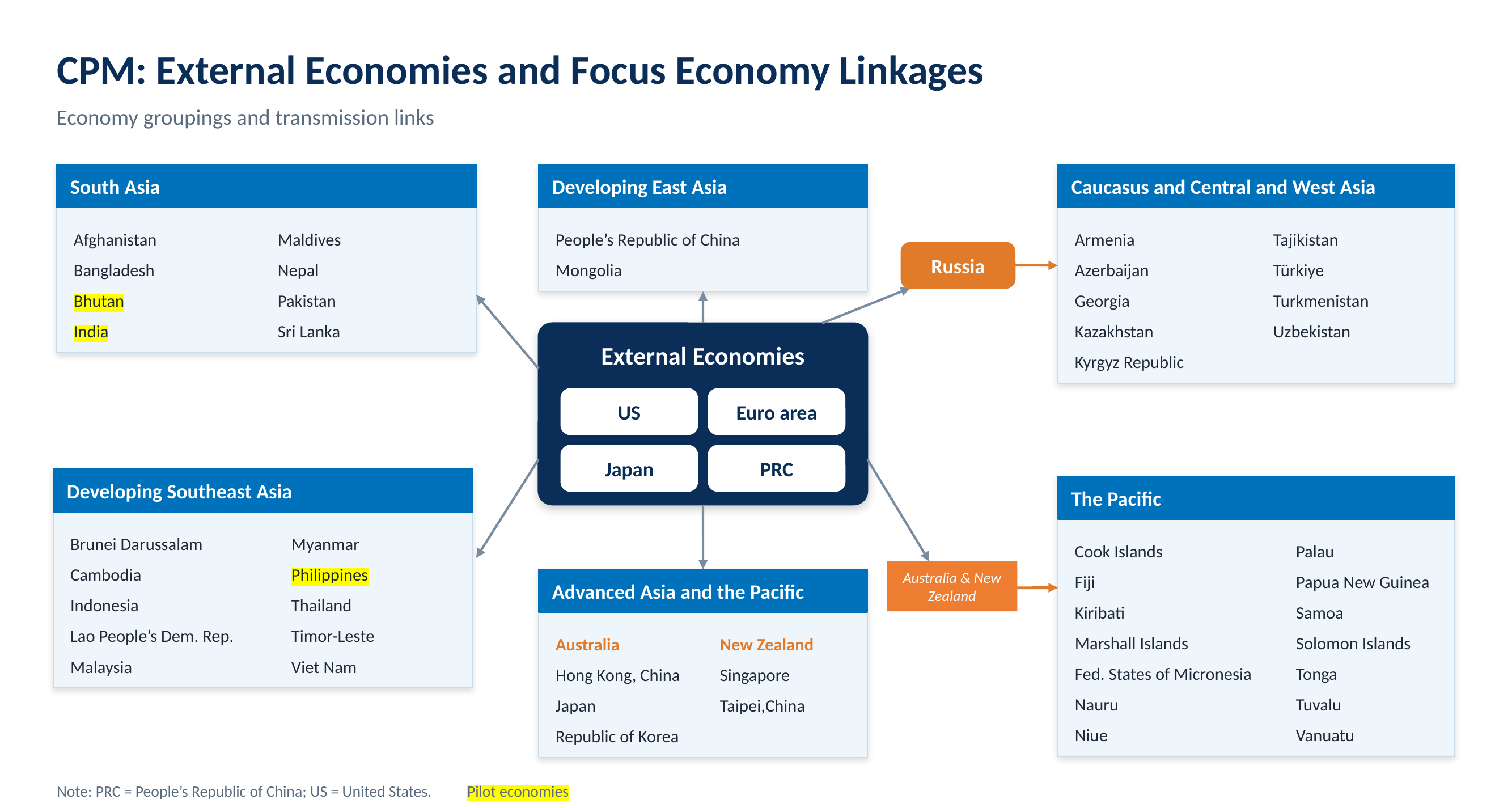
The CPM links each focus economy to a common external environment made up of four economies: the United States (US), the euro area, Japan and the People's Republic of China (PRC). Developing Asia economies are grouped by subregion, and Bhutan, India and the Philippines are the pilot economies.
CPM Tool Structure
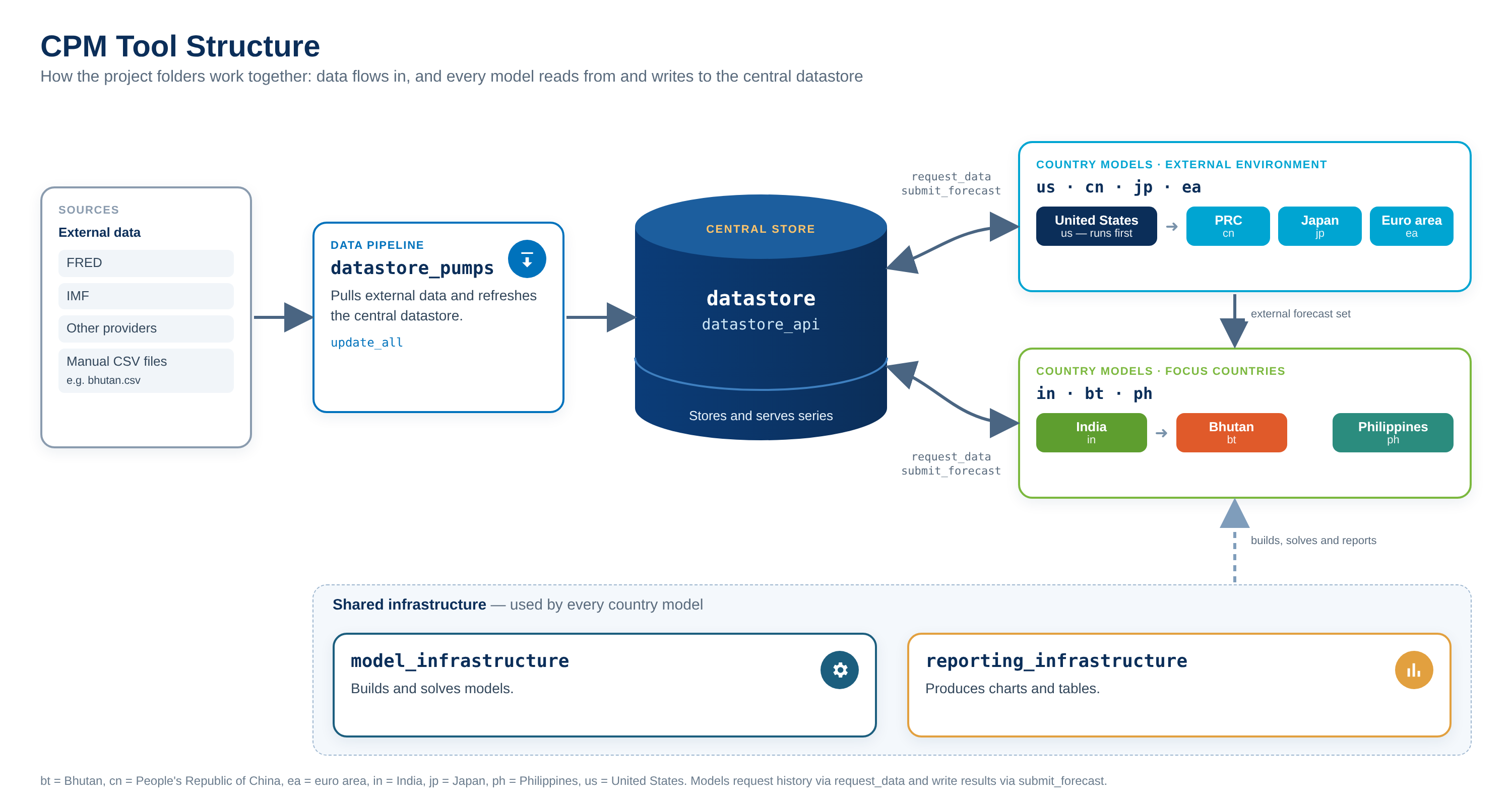
The project folder is organised into infrastructure modules and country modules.
| Folder | Role |
|---|---|
datastore_pumps |
Pulls external data |
datastore / datastore_api |
Stores and serves series |
model_infrastructure |
Builds and solves models |
reporting_infrastructure |
Produces charts and tables |
us · cn · jp · ea |
External environment models |
in · bt · ph |
Focus-country models |
Country folder contents
Each country folder contains the scripts for the nine model steps, together with key files such as attributes.json, create_model.py and a data_files/ folder.
Forecasting Process
A forecast round moves through three stages. Each stage depends on outputs saved to the datastore by the stage before it.
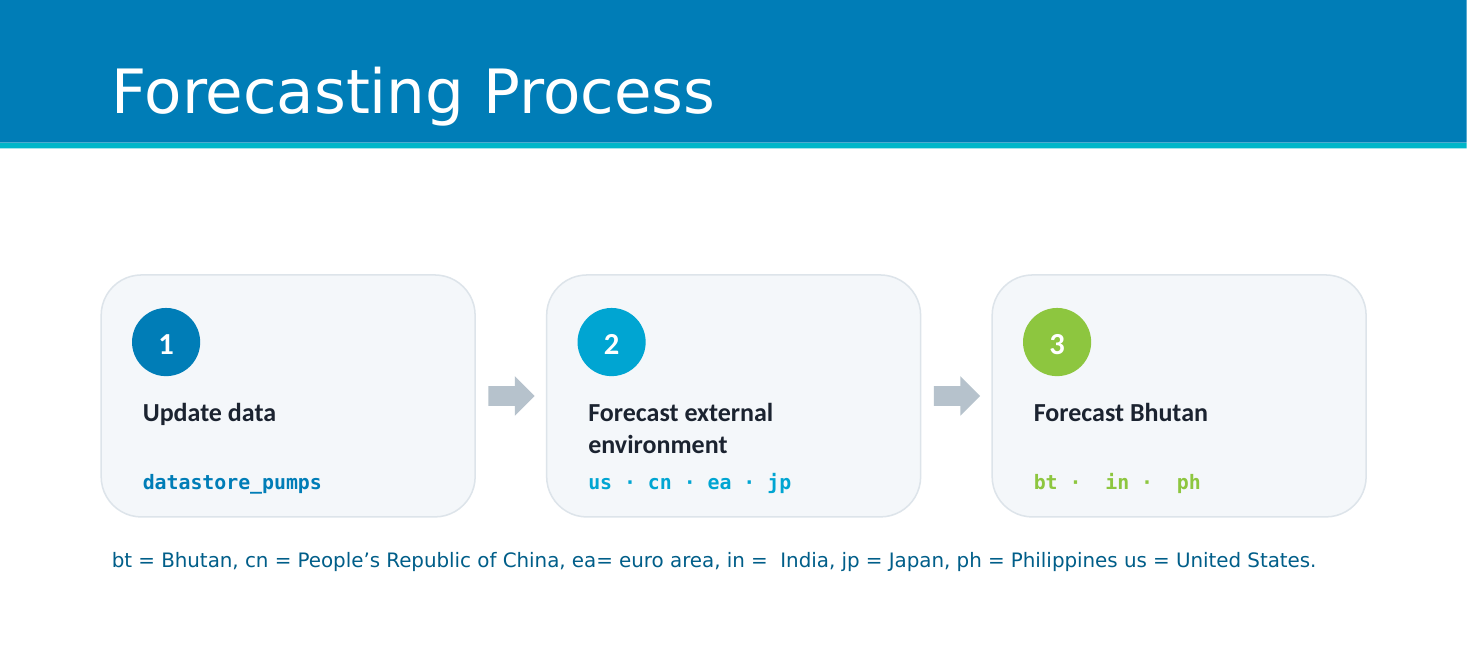
| Stage | What happens | Where |
|---|---|---|
| 1. Update data | Refresh the central datastore with the latest data | datastore_pumps |
| 2. Forecast external environment | Run the US first, then the PRC, Japan and the euro area | us, cn, jp, ea |
| 3. Forecast focus economy | Philippines and India can run in parallel. Bhutan depends on India due to currency peg. | ph, in (and then bt) |